by Rick Stomphorst
Do you love building relationships with customers and influencers? Do you love helping to solve customers’ problems? Do you love the pre-sales side of customer management? If so, then this role may be for you.
The successful candidate will have customer success, customer service, or sales support experience dealing with international corporate buyers, responding to their product inquires, providing quotes, and generally ensuring overall customer satisfaction so they will renew.
This is not an outbound sales role. You carry no quota and there is no cold calling (whew!).
About the Job
The purpose of this role and why this role exists
- To ensure overall customer satisfaction so they will renew
- To handle in-bound product inquiries, responding with web demos, quotes and invoices
Top Responsibilities
The part that you play in this organization, and specific duties you are measured against
- Customer Engagement:
- Working with prospective end-clients ensuring they understand the product’s value proposition, often by asking them the right questions
- Delivering sales presentations and web demos
- Providing quotes and invoices, following up on quotes
- License Management for renewals and trials. Proactively look at churn and contact customers at risk prior to renewal time and track information regarding any cancellations
- Advocate our product and services to existing or prospective customers
- Inspire clients to think strategically about how our product can support their business needs
- Collect customer stories about successes using our software
- Vendor management – working with resellors, producing quotes and invoices
- Customer Advocacy – ensuring we are providing superior service and support to ensure customers are successful and renew
- Trusted Adviser – Coach customers on the best practices of using our software, and the use and benefits of our products
Some of the Experiences & Background we’d like to see
All the things you’re good at because you’ve done most of these before
- Post-Secondary degree in a business-related field (Marketing, Sales, Management, Communications)
- 3-5 years experience in B2B Customer Success, Customer Service, Customer Advocacy, Pre-Sales, or Sales Support roles within a technology company
- Strong remote presentation skills
- Demonstrable experience delivering value propositions for pragmatic and conservative enterprise-sized buyers
- A willingness to take the initiative
- An exceptional attention to detail
- Excellent business-level verbal, written, copy-writing, and presentation skills. Efficient communications is king
- Ability to manage multiple competing priorities
Additionally Desired Experience
- A successful candidate will bring a technical background with an understanding of B2B business workflows
- Authoring procedural documentation
- Experience in a software company
- Experience with CRMs
Candidates must be legally entitled to work in Canada and must be able to travel intermittently to the United States
Sound like you? Sent your resume to rick@searchvelocity.ca now!
Please include your resume.
About the Company
Our client is a growing 6-year old company which has already attracted 3,000+ Enterprise-level clients from over 70+ countries including Fortune 500 companies. These clients now rely on our client’s solutions to integrate data between their various applications. They have become a leading provider of data integration.
Application integration is a painful and daunting task, typically costly and inefficient to develop. To address this, our client has developed robust value-add additions which leverage existing Microsoft integration offerings. Their software solution is cost-effective and easy for developers to use.
They offer a relaxed work environment, walking distance to eateries, and healthcare spending account.

by Rick Stomphorst
This blog touches on the unanticipated findings during your on-boarding process.
You understood your new company to be mature yet you’re discovering it to be very immature. You’ve discovered there are few documented processes, everyone seems to be fighting fires and there isn’t a HR policy manual. Or vise versa, everything has a documented procedure and there is no room for innovation.
You have a fixed amount of time to investigate a new employer during the interview period. Performing an exhaustive research to make an 100% informed decision about the new employer is impossible. For example, during a merger or acquisition, professionals using a tried & true process to research the to-be-acquired company, and they still can’t find everything. You research the company in the time allotted and to the best of your abilities.
STARS
Businesses exist in one of four phases of in their lifespan, which Author Michael Watkins refers to the STARS model:
- Startup
- Turnarounds
- Accelerated Growth
- Realignment
- Sustaining success
Startup – The company is trying to launch a new business, product or service. Limited financial resources, employees are usually less focused on key issues, there is ongoing excited confusion, your assembling startup’s capabilities, corporate memory is virtually non-existent – residing with a few key resources – the company’s primary goal is often fiscal survival. You must channel the excited confusion into a productive direction. You need measurable goals and create value, often requiring tough calls. By definition, startups are on the offensive requiring hunter type management.
Turnaround – Stakeholders know what the problems are, but not what to do about it. For example, the product is at end-of-life with no replacement in sight or a competitor has been relentlessly eating away at your business greatly eroding the financial viability of the business, but at least the team recognizes the consequences and they are hungry for hope. At any given time, between 20 and 30 percent of all companies are in need of a turnaround (J. Murphy 1986). Staff may be demoralized. You need to teach people the need for change and about the problems. Your business, process or product takes on a defensive strategy. You have one goal, which is to get to a defendable line, meaning you’ll have to make tough calls. Again, hunter type management is required.
Accelerated Growth – Managing a rapidly growing business. Putting processes and systems in place to enable the business to scale. The growth helps motivate people who will in-turn stretch themselves to achieve objectives.
Realignment – People are unwilling to see the forest for the trees, they are in denial. The challenge is dealing with ingrained cultural norms and convincing employees that change is necessary. You will still likely to have strong people, products or technologies. You have to create a sense of urgency. A farmer management type is needed here. Hunter type management types don’t work well here.
Sustaining Success – This is the plateau companies strive for. Complacency sets in. Innovation slows. You have to create a new challenge to fend off complacency and find new areas to succeed or grow. A farmer management type is needed here to take the company to the next level.
Multiple Phases
It’s not uncommon to find a company existing in multiple phases of a business’s life cycle. Various departments, products or systems/processes may each exist in a different phase. For example
- A Sustaining Success firm could be launching a new product line, which falls into a Startup category,
- A company may have just been acquired by a firm in Turnaround.
You need to identify where each key department, product, or process exists in the STARS model. This will enable you to procedurally tackle the unique issues in each category with a common framework unique to that category.
Take some time to categorize your new situation as this will aid in strategizing your approach to each. Categorize the departments, processes and products as you learn about them.
There is much business literature on the various phases of businesses. If you find your business / department / process / product entrenched in any particular state, suggest learning more about that one specific phase.
<< Previous Blog | Next Blog in Series >>

by Rick Stomphorst
It’s human nature to gravitate towards areas that interest us most. These areas become our preferences. However, these preferences, as it relates to problem solving, may become a blind spot and harm you during on-boarding.
Table 1-2 below, from Watkins’ The First 90 Days, is a simple method for assessing your preferences for different kinds of business problems, for identifying your blind spots. Complete this table by assessing your intrinsic interest in solving problems in the domain in question, not by assessing your skills or experience.

Table 1-2
When complete, transpose the values in these 15 cells into the 15 cells in Table 1-3 below, (again from Watkins’ The First 90 Days). E.g. Green Row1-Column1 to Green Row1-Column1.
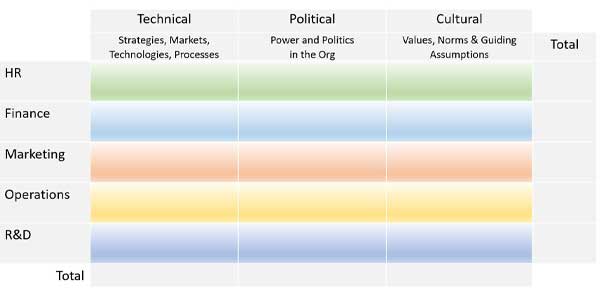
Table 1-3
Lastly, calculate the totals. If one column total is noticeably lower than the others, this represents a potential blind spot for you.
The row totals represent your preference for various business functions. For example, if Marketing is low but represents a success criteria for you, you need to be cognizant of that develop a mitigation strategy.
Most people are unable to articulate, or don’t really know their preferences. This method provides you with the means to measure what you enjoy and don’t enjoy working on.
<< Previous Blog | Next Blog >>

by Rick Stomphorst
Excelling at on-boarding at a new job is a skill as it’s common to change roles every 2-3 years. Here are four areas of risks when on-boarding.
1. Aligning your Strengths & Vulnerabilities to the New Role
While it’s typical to blame an on-boarding failure on the new person, failure is never all about mistakes they made. New hires who have been very successful in past roles, can still fail in a new role. A strength you had a previous role may become a weakness in a new role. Failures occur when:
- a new person doesn’t understand or refuses to accept the true situation they find themselves in (reality may have been portrayed differently during the interviews)
- the preexistence of time bombs
- failure to adapt appropriately to the given situation
2. Failure to Build Sufficient Momentum to Establish your Credibility
Failing to build momentum could result in your credibility being eroded during each interaction or meeting. We either gain credibility or lose it.
As the human body treats a virus, so can an organization treat a new hire. The organization’s immune system instinctively could whip into action to isolate then destroy the potentially killer infection (i.e. You).
3. Not using a Systematic Method in your On-boarding
While every on-boarding is unique, there is a high degree of similarities between them. Make on-boarding a repeatable successful process by creating a framework. Each time you switch jobs, your plan will get stronger.
4. Not Aligning your On-boarding to the Current Phase of the Business
The book The 1st 90-Days introduces the STARS model. Companies, departments, products and/or processes exist in one of four phases of existence:
- Startup mode
- Turnaround mode
- Accelerated Growth mode
- Realignment mode
- Sustaining success mode
STARS model allows you to identify and differentiate between the business cycles you’re in, and its related unique characteristics and challenges. The key is to match your on-boarding strategy to the STARS phase of your company.
Assuming a transition takes between 3 – 6 months, over the course of your career you’ll be immersed in on-boarding for 3 – 8 years. A good practice to get good at it.
<< Previous Blog | Next Blog in Series >>

by Rick Stomphorst
As a new employee you need to progress to the point where you’re giving back more to your employer than you’re costing them. In fact, your job may be a risk if you don’t get to the break-even point fast enough.
The actions you take in the first 3 months often dictate your fate: you either succeed or not. You are vulnerable during the first 3 months. You need to build momentum or you will be faced with a mounting up-hill battle.
While transitions and on-boarding’s are fraught with risk, they’re also an important business necessity. Introducing new people to an organization introduces new ideas, preserves vitality, and enables a company to grow.
Feel you’re over your head in your new position? You’re not alone. Some 25% of Managers enter new roles and/or companies each year in Canada. All those transitions will not go well.
The risks are that the new person is unfamiliar with the culture, politics, informal lines of communication, systems and processes, products, markets and the know few people. You are under a microscope.
You’re not the only one transitioning. If in a Management position, your direct reports, in-direct reports, peers, managers and clients are all also in in-direct transition. Additionally, it’s not uncommon to have more than one person in transition or on-boarding at a time within a business, representing an even greater percentage of the staff who are also experiencing in-direct transition and whose performance may be negatively impacted because of it.
Failing an on-boarding or transition is a blemish on your resume. It is also expensive for the hiring company. Some sites note that it can cost a company 24x base compensation for a failed hire.
Value Proposition
Consider how many times in your career you’ll be switching jobs and/or companies. Imagine if you would reduce the break-even point of your on-boarding by a few months each? Best to get good at on-boarding and transitioning.
<< Previous Blog | Next Blog in Series >>