by Rick Stomphorst
You were hired because you are smart. Your employer has a high level of confidence in you. You were the best candidate! They want you to succeed.
Here are 5 tips to help you through the employment probation period.
1. Work Longer
A good work practice is to work an extra 15-30min at the end of the day. This will look positively on you.
Consider this, invariably staff who commute a distance will be unexpectedly late due to weather, traffic, public transit delays, etc. The “banked” minutes/day balances out against the days were the trip in takes unexpectedly longer, days where you need to leave a little early, or have a long lunch. It’s a good practice to know in the back of your mind that you have “time banked”.
Related, arrive ready to work. It’s a poor practice to arrive precisely on time only to proceed to get your coffee, engage in small talk, then turn on your computer & get setup to start work.
2. Double and Triple Check Your Work
Mistakes made in the first 90 days have a greater impact on you and your fledgling tenure than when you’re a “long term” employee.
3. Admit Mistakes
We all make mistakes. Admit any mistakes you make. Mistakes are proof that you are trying.
4. Learn
Be inquisitive. You’re new. Ask lots of questions. Take notes. Learn. Doing the opposite implies you’re not interested, don’t understand or not serious.
Seek training. If the company doesn’t provide training or peers have insufficient time, seek out webinars, vendors or training videos on YouTube. For company products, ask which are the top 1, 5, or 10 products you should focus on learning. Read manuals.
5. Manage Your On-boarding
Build a 30-60-90 day on-boarding plan. Minimally, have daily or weekly plans.

by Rick Stomphorst
Every year about 25% of managers change jobs. Some get promoted, some laterally, and some transitioning into new companies. Virtually no one plans an onboarding strategy and as such, 75% of transitions fail to reap expected gains. “John looked so promising” but he’s “underperforming” or “not fitting in” are common complaints. In addition to the 25% of managers changing jobs yearly, it’s not unrealistic to say that company’s have a 10% staffing churn yearly.
You want to leave a positive impact during your era in the company or role, not a failed on-boarding.
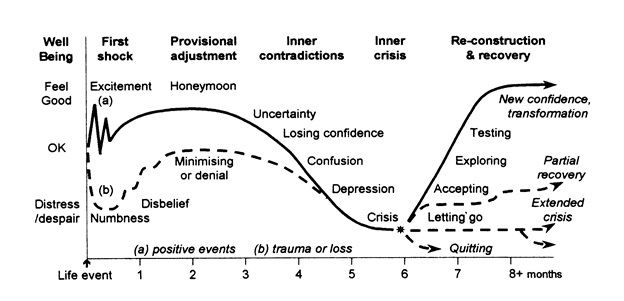
Hopson Transition Curve
Have you ever studied the process of integrating yourself into a new company, or new role within your company? The vast majority would answer “no”. Compared to business books on other practices, there are surprisingly limited resources on onboarding. The result is a onboarding roller coaster ride called Hopson transition curve.
Most companies struggle with onboarding new staff or transitioning existing staff. Most will understand very little about the transition curve. Most companies are “reactive” in nature to onboarding or transition problems.
Why Study Onboarding?
Everyone can remember criticizing the new idiots at the helm (if you’re one of my ex-managers reading this, I wasn’t referring to you – you were the exception). We criticized their decisions, their tactics, their people skills, their approaches to problems. If you don’t study how to onboard successfully, you become one of those idiots, or worse, your employment is terminated.
On-boarding Management as a Differentiator
There are plenty of solid business books and university/college courses on Business Management, but surprisingly, very few on on-boarding.
Many organizations provide new hires with a short-term orientation session, in hopes to acclimatize you to their (your new) company. One company that does excel in management training is GE. The excellent book Good to Great notes that many GE trained managers have gone on to become heads of major companies. Planning and training for onboarding does work.
Like most, you learned onboarding the hard way, the sink or swim model. You learned from your successes and hopefully equally from mistakes. Much of the onboarding process we know and execute at a subconscious level, is never put into a transition plan, a transition framework. After studying the topic, my recommendation is to develop your own onboarding plan.
This is the first in a series of blog posts on the topic of Onboarding. My objective is to eliminate the valley in the transition curve.
On-boarding Definition
- Promotion, lateral move
- Acquiring staff for the first time
- Joining a new company
- Any functional change in your responsibilities
- Same role, same company, new geographical location
Prior to Your Start-Day
Learning begins prior to joining the new firm or staring the new role. Your personal learning meter should be running from the moment you learn you’ve landed the job.
There’s a number of learning tools at your disposal to aid in ramping-up before you join:
- Ask your new employer for any additional relevant documentation, for example: recent staff and/or client surveys or focus group results, meeting minutes, product focus groups, whitepapers, manuals
- Learn about the organization’s people, structure, performance (annual reports) and clients
- Google the firm, their products, their people, product reviews, etc.
- Search product reviews, blogs, and relevant Twitter accounts (i.e. follow their people, clients, suppliers, if not already doing so), Youtube, etc.
- Speak with suppliers and customers. You may circle back to these same people later on in your learning plan
- Speak with former employees (ideally from within your network)
- Speak with your predecessor or ex-staff if possible. Linkedin will find them
- Learn the company’s strategy
- Meetup with your new manager for a structured meeting
- Try the product if possible and applicable
- Use the above to being compiling your unique initial questions to start the journey once “on the inside”.
This is the first in a series of Job Transition blogs, written to help you during your on-boarding journey.
(Reference)
Next Blog in Series >>

by Rick Stomphorst
Below is an actual stack of biz cards that I collected over a few years. It represents unrealized opportunities.
I recently un-buried myself from all the business cards I’ve collected over the past few years. While filtering through the cards, two ~equally sized piles emerged. The first evolved into two categories of connections:
- People whom I’ve stayed connected with, and,
- People I see a potential future relationship
The latter is what I call “loose connections”. These are people I intend to stay connected with.The second consisted of connections that did not evolve, I could not identify joint opportunities for us, nor did they. Any potential relationship has seemingly ended. Didn’t get to 2nd base.
But what does this mean? It’s not necessarily a bad thing, just reality of the networking world shaking hands around us.
While taking a second pass over the “did not evolve” stack, it became clear that many simply did not state the value of its owner, just name and coordinates, a mystery novel left for me to unravel.
How do you succinctly communicate your value prop on a biz card? How do you ensure that after the customary exchange of personal identifying rectangular coloured paper has long since past, that someone will actually remember you, what you do and what value you can provide?
Isn’t that what’s it all about?
 What are my business card preferences? Beyond the mandatory name, company name & website, and email address, my preferences are:
- Your Twitter ID
- Clean and easy to read
- A logo or style that resembles or embodies what value you provide
- LinkedIn URLs on the card if your profile is not easily identifiable , otherwise it’s clutter.
- White space on your card so I can scribble notes on it. I need to write the date, location, and why & where we met. Dark cards or glossy cards that prohibit that.
- Unique card stock size format
- I don’t need your street address or fax number
Through Silicon Halton I receive many business cards. How will you help me remember you? My job is connecting talent to employers, people to people, and business to business. I can help you if I clearly know who you are. Don’t write me a mystery novel.

by Rick Stomphorst
Do you love building relationships with customers and influencers? Are you technically inclined? Do you love helping to resolve customers’ problems? Do you love the pre-sales side of customer engagement? If so, then this role may be for you.
The successful candidate will have hands-on customer success, technical support, customer service, or sales support experience ensuring overall customer satisfaction so they will renew and responding to the pre-sales product questions.
About the Job
The purpose of this role and why this role exists
- To ensure overall customer satisfaction so they will renew (80%)
- To handle in-bound product inquiries, responding with web demos, quotes and invoices (20%)
Top Responsibilities
The part that you play in this organization, and specific duties you are measured against
- Customer Advocacy – ensuring we are providing superior service and support to ensure customers are successful and renew
- Customer / Reseller Engagement – Working with prospective clients ensuring they understand the product’s value proposition, often by asking them the right questions and answering their technical questions
- Providing quotes and invoices, following up on quotes
Some of the Experiences & Background we’d like to see
All the things you’re good at because you’ve done most of these before
- Post-Secondary degree in a business-related field (Marketing, Sales, Management, Communications)
- 3-5 years experience in B2B Customer Success, Technical Support, Customer Service, Customer Advocacy, Pre-Sales, or Sales Support roles within a technology company
- Strong remote presentation skills
- A willingness to take the initiative
- Exceptional attention to detail and well organized
- Excellent business-level verbal, written, and presentation skills. Efficient communications is king
Additionally Desired Experience
- A successful candidate will bring a technical background with an understanding of B2B business workflows
- Authoring procedural documentation
- Experience in a software company
- Experience with CRMs
Candidates must be legally entitled to work in Canada and must be able to travel intermittently to the United States
Sound like you? Sent your resume to rick@searchvelocity.ca now!
Please include your resume.
About the Company
Our client is a growing 6-year old company which has already attracted 3,000+ Enterprise-level clients from over 70+ countries including Fortune 500 companies. These clients now rely on our client’s solutions to integrate data between their various applications. They have become a leading provider of data integration.
Application integration is a painful and daunting task, typically costly and inefficient to develop. To address this, our client has developed robust value-add additions which leverage existing Microsoft integration offerings. Their software solution is cost-effective and easy for developers to use.
They offer a relaxed work environment, walking distance to eateries, and healthcare spending account.

by Rick Stomphorst
I often hear from LinkedIn citizens that they’re pestered by recruiters about jobs, how they find it a huge annoyance, unprofessional, spammish, and they won’t reply. But what if recruiters were not contacting you?
Having a recruiter contact you is an affirmation that a) your skills are in demand and b) you can be found. Without both, the professional-you may be approaching the end of it’s shelf life.
Unlike our parents era, no one is looking out for you and your career. This is now your responsibility. You could be tapped on the shoulder tomorrow, or while you’re reading this, that your services are no longer required.
LinkedIn has democratized human capital. Virtually every one in every vertical should be on LinkedIn, whether you’re a professional commercial painter, electrical supplies salesperson, or work in technology, you’re doing yourself a disservice for not being on LinkedIn.
By not being on LinkedIn and/or not sufficiently describing your skills:
- You’re losing track of solid connections that could help you find your next job (and vise versa)
- You’re losing track of key connections that would provide references during the hiring process (and vise versa)
- You’re unable to share your industry, technical or business knowledge to your inner circle, and learn the same from your network. A great way to keep you, and them, up-to-date
- You’re keeping your salary depressed.